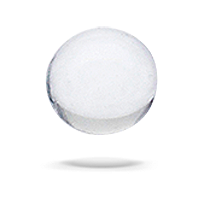
Glass microbeads
Clean, safe, dust-free – stable processing without risk
Who were glass microbeads (spheres) created for?
For anyone who expects a clean process, consistent results, and peace of mind. They are suitable for both advanced production lines, where process stability and cleanliness are a priority, and for smaller companies that simply need a product that performs consistently. Ideal for: manufacturers of stainless steel and aluminum components, food, pharmaceutical, and medical companies, automotive and aerospace companies, entities performing satin-finishing or polishing of components, and service companies requiring a low-dust, repeatable solution without unnecessary experimentation.

Tell us about your company’s situation and see if glass microbeads can solve your problem.
What distinguishes glass beads from other standard solutions?
- Consistent batch quality – no dust, impurities, or foreign particles.
- No sharp edges – balanced processing.
- Reproducible visual effect – whether satin or delicate silver plating.
- No free silica – safer for operators and equipment.
- Reusable – the beads are compact, do not break, and do not produce dust.
- Work comfort – low dust = better visibility and less discomfort for operators.
- Additionally, microbeads do not chemically react with the material, making them indispensable for components requiring the highest purity.
Production method and structure are the key to success
The beads are made from virgin, high-quality soda-lime glass, class “window glass.” They are not recycled and do not contain any alcohol, chemical, or plastic residues. This is a significant difference, especially when you care about clean air in the hall, odorlessness, low dust levels, and consistent quality of the fractions.
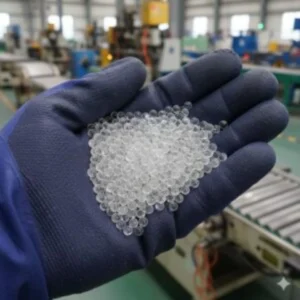
In what industry are glass microbeads suitable?
Stainless steel and aluminum production
Repeatable processing of steel and aluminum components – no damage, no discoloration, no worries.
Food and pharmaceutical industry
Processing of components in contact with food or medicines. Safely, without contamination, and in compliance with sanitary regulations.
Automotive, aviation, precision mechanics
Matting and smoothing delicate details made of titanium, aluminum, and stainless steel.
Faster, cheaper, more effective We implement effective processes surface treatment
Is your company in a different industry? Great.
Glass microspheres are also an ideal material for: polishing jewelry and watches, cleaning electronics, finishing composites and laminates, therapeutic applications as a filler for weighted blankets, or as an additive to exfoliating cosmetics – anywhere where chemical inertness, sphericity, and safety are important.
Does your process need urgent improvements?
How to choose glass microspheres for the glass blasting process?
How do we implement glass microbeads in customer companies?

Process Analysis – We don't begin projects without a thorough understanding of the current process. Therefore, in the initial phase of the project, we carefully analyze the client's current challenges and problems to identify potential optimization opportunities. If we jointly determine that the current state can be improved qualitatively and economically, we continue the project.

Measurements and testing – We come to the client for a process audit. We verify machine settings, collect samples, interview operators closest to the process, check the surface blasting level, and analyze the results.

Testing and training – To reduce the risk of changes introduced to the client's conditions, we conduct tests on selected materials at our testing center in Łódź. We evaluate the results, consider potential adjustments, and then prepare an action plan for the coming months. We train employees in areas that require increased attention and implement necessary procedures that will allow the team to maintain established process parameters in the long term.

Process Support – We continue our project collaboration. We provide regular support to periodically monitor the process after changes are made to the client's process. This allows clients to better understand the key quality and financial aspects of their machining.

Technical information
Attributes
Material:
Soda-lime glass
Applications:
Cleaning, Smoothing, Peening, Micropolishing, Surface preparation for coatings, Decorative finishing
Shot blasting systems:
Pneumatic shot blasting machines (pressure cabins, injector cabins)
Hardness:
6 – 7 on the Mohs scale
MOQ:
1000 kg
Pakowanie
Spreading table
40 µm-80 µm
70 µm-110 µm
90 µm-150 µm
100 µm-200 µm
150 µm-250 µm
200 µm-300 µm
300 µm-400 µm
400 µm-600 µm
400 µm-800 µm
600 µm-800 µm